
Cinnamon sticks aren’t just for spicing up tea or baking apple pie. In the global spice trade, they’re a high-demand ingredient that powers food brands, beverage companies, and wellness products across continents.
So when someone asks “Where to buy cinnamon sticks?”, the real question is: Are you looking for convenience — or for quality, consistency, and traceability?
If you’re sourcing for business, choosing the right supplier can make all the difference. Here’s what you need to know.
First, know what kind of cinnamon you’re buying
Before deciding where to buy cinnamon sticks, it’s essential to understand not all cinnamon is the same and there are two main types of cinnamon.
Ceylon cinnamon, often referred to as “true cinnamon,” comes primarily from Sri Lanka. It’s much milder, with thin, fragile bark and a lighter aroma. While prized in certain niche markets like premium teas or desserts, Ceylon cinnamon is less common in industrial applications due to its higher price and lower oil content.
Cassia cinnamon is the most common type in global trade. It’s grown primarily in Vietnam, Indonesia, and China, and is known for its dark reddish-brown bark, strong spicy flavor, and high essential oil content (2–5%). Because of its bold profile and affordability, cassia is widely used in commercial food production, beverages, herbal formulas, and spice blends.
Among cassia-producing countries, Vietnamese cassia (often called Saigon cinnamon) stands out. Grown in the highland provinces of Yen Bai, Lao Cai and Quang Nam, Vietnamese cinnamon benefits from rich red soil, cool mountain air, and traditional harvesting methods. This results in sticks that are thicker, more aromatic, and richer in cinnamaldehyde — the compound responsible for cinnamon’s signature warmth.
At VietGlobal Export, we specialize in Vietnamese cassia cinnamon sticks — a variety prized for its sweet-spicy aroma, rich color, and versatility in both culinary and wellness industries.
Quality matters – here’s what to look for
If you’re sourcing for retail, wholesale, or food manufacturing, the quality of your cinnamon sticks directly impacts your final product.
Here are five signs of a high-quality cinnamon stick:
- Strong aroma: A sweet-spicy scent that’s immediately noticeable when you open the bag.
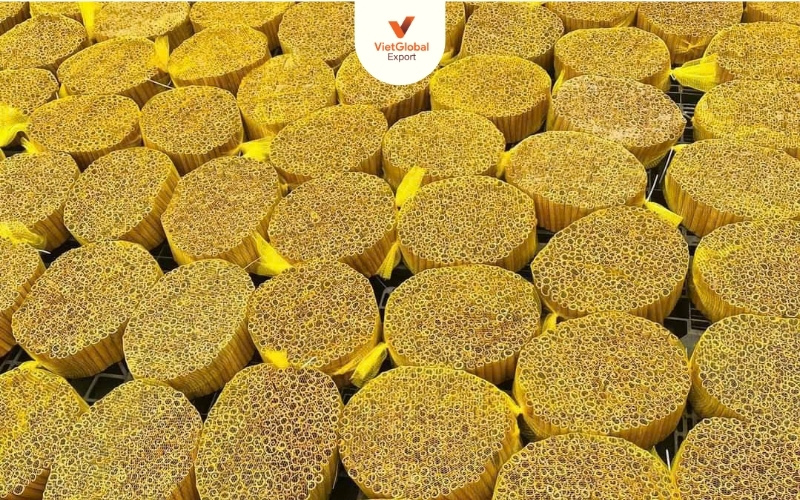
- Tight, natural curls: Sticks should be well-rolled and not cracked or flattened.
- Clean surface: No mold, excess bark, or black spots.
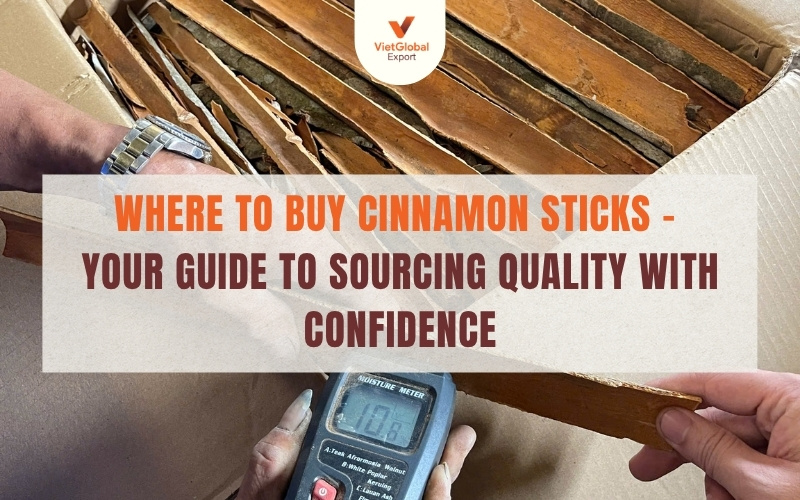
- Low moisture: Ideally below 13.5% to preserve shelf life and prevent microbial growth.
- Consistent grading: Uniform size and thickness, sorted by hand or machine.
Where to buy cinnamon sticks – 5 sourcing options (and which one is right for your business)
For B2B buyers, choosing where to buy cinnamon sticks is not simply a purchasing decision — it’s a supply chain strategy.
Whether you’re an importer, a food manufacturer, or a wellness brand sourcing ingredients at scale, the supplier you choose impacts everything from product quality to brand reputation, pricing margins, and compliance.
Let’s break down the most common sourcing channels — with a critical lens on what works (and what doesn’t) for bulk buyers and international trade.
1. Local wholesale markets
In some countries, especially in spice-consuming regions, you can find cinnamon sticks in local spice markets or domestic wholesale hubs. While this offers the benefit of speed and direct handling, it’s often not viable for large-scale or export-focused businesses.
The main challenges include:
- Unclear origin – You rarely know where the cinnamon was grown or when it was harvested
- Lack of grading and documentation – Moisture levels, oil content, or microbiological testing are typically not available
- Inconsistent quality – Product appearance and aroma can vary by lot
- Limited scalability – May not support container-level volumes or repeat orders
This option is only suitable for businesses buying small quantities for domestic use or short-term trial runs — not for those building an international brand or operating on export-level volumes.
2. Supermarkets and retail stores
Retail chains and grocery stores often stock cinnamon sticks in jars or pouches. While convenient for home cooks or boutique businesses sourcing very small amounts, this channel is not built for B2B needs.
Why it doesn’t scale:
- Retail markup is high — pricing is not optimized for margin
- Small pack sizes — usually 50g to 200g per unit
- No direct relationship with producer
- No customization for packaging, grade, or private label
In short, this is an option for consumers — not importers, distributors, or food manufacturers.
3. Online marketplaces (Amazon, Alibaba, etc.)
Typing “cinnamon sticks for sale” into Amazon or Alibaba will yield thousands of results. Some offer attractive pricing or fast shipping. But if you’re sourcing for export or business use, there are major risks to consider.
Here’s what to watch out for:
- Many sellers are brokers or intermediaries — meaning higher markups, lower transparency, and reduced control
- Lack of traceability — you may not know which farm or region the cinnamon came from
- Certifications may not be verifiable — many sellers list terms like “organic” or “HACCP” without supporting documentation
- Batch-to-batch inconsistency — quality may vary, especially if sellers are not processing the goods themselves
Online platforms can be a starting point to understand market pricing or get samples — but relying on them for long-term B2B supply is rarely sustainable.
4. Specialty D2C spice brands
Some direct-to-consumer (D2C) spice brands offer premium cinnamon sticks with impressive transparency. They may even show you the farm or region, share harvest stories, or provide certified origin information.
For retail or consumer use, this is excellent. But for B2B, it has limitations. Why?
- High unit cost – These brands operate with retail profit margins
- Not built for volume – MOQs are low, but capacity is limited
- Packaging is fixed – Often jarred or boxed, not in bulk formats
- No OEM or private label options – Not ideal for wholesalers or F&B brands needing custom branding
These sellers serve a different segment — not industrial buyers or international distributors.
5. Direct-from-origin manufacturers and exporters
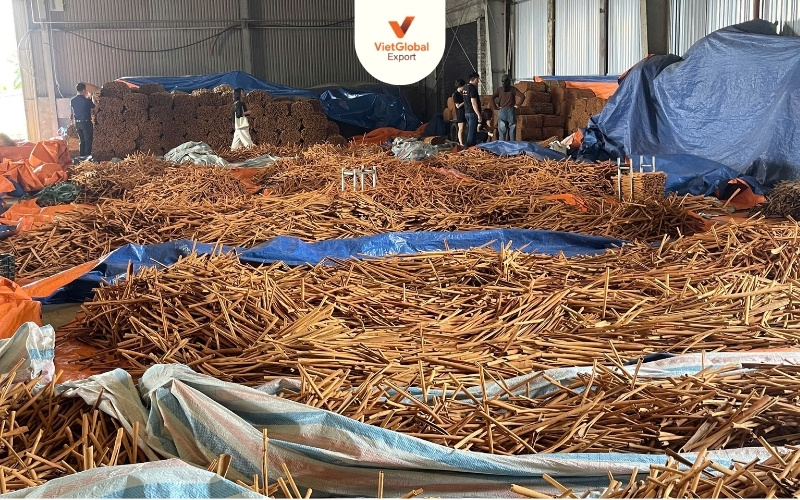
For B2B buyers — especially those importing full containers, developing spice brands, or manufacturing at scale — working directly with exporters from origin countries like Vietnam is the most strategic and cost-effective choice.
Why this option works best:
- Farm-to-factory traceability – You know exactly where your cinnamon comes from
- Consistent grading and oil content – Measured, tested, and documented
- Flexible volumes – From MOQ 1 ton up to full containers (FCL)
- Custom packing & private label – Ideal for foodservice, retail, or OEM needs
- Export documentation – Includes CO, Phytosanitary, HALAL, Organic, SGS on request
- Long-term supply security – You build a relationship, not just a transaction
At VietGlobal Export, this is exactly what we do. Based in Hanoi, with direct access to cinnamon farms in Yen Bai and Lao Cai, we manage sourcing, processing, packing, and logistics — all under one roof.
Ready to buy cinnamon sticks in bulk?
If you’re still wondering where to buy cinnamon sticks that are flavorful, export-ready, and backed by real expertise — look no further.
VietGlobal Export is your trusted cinnamon partner from Vietnam. Let’s build a sourcing solution that meets your quality standards, your budget, and your brand’s promise.
📧 Email us at sales@exportviet.com
🌐 Visit our website: www.exportviet.com
📱 WhatsApp: +84 812 540 881
