
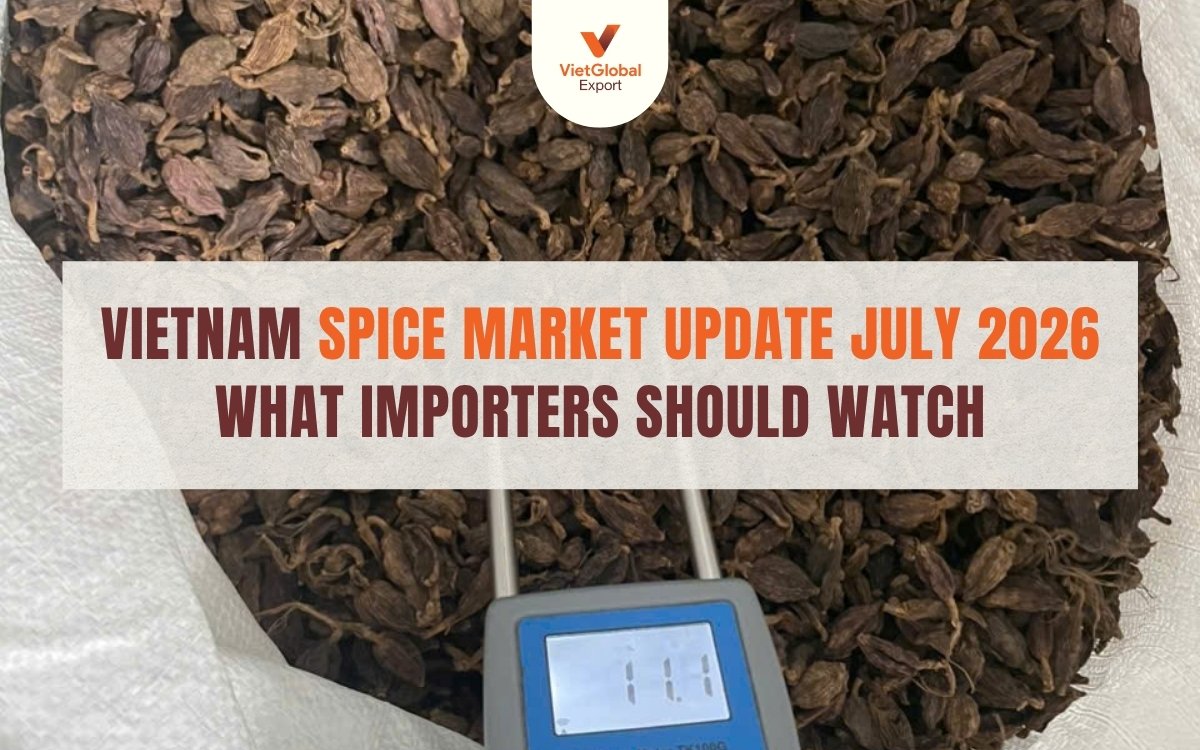
July is not the same sourcing period for every Vietnamese spice.
While cassia cinnamon has entered the quieter period between its two main peeling seasons, black pepper is being traded mainly from existing stocks. Star anise is moving from the completed spring crop toward the autumn harvest, while black cardamom is beginning its short and closely watched new-crop period.
For international buyers, understanding these differences is important.
Availability on paper does not always mean that the required quality, grade or quantity is ready for shipment. Weather, stored inventory, drying conditions and farmers’ selling decisions can all affect actual supply.
Here is what the VietGlobal Export team is currently seeing across Vietnam’s key sourcing regions.
July 2026 Vietnam spice market at a glance
| Product | July crop position | Main sourcing concern |
| Cassia cinnamon | Between the spring and autumn harvests | Tighter raw material and higher moisture risk |
| Star anise | Transitioning toward the autumn crop | Early-crop quality and moisture-proof packing |
| Black pepper | Post-harvest, inventory-driven market | Stock availability and short-term price volatility |
| Black cardamom | Early harvest period | Pod maturity, drying quality and limited supply |
Each product therefore requires a different purchasing strategy.
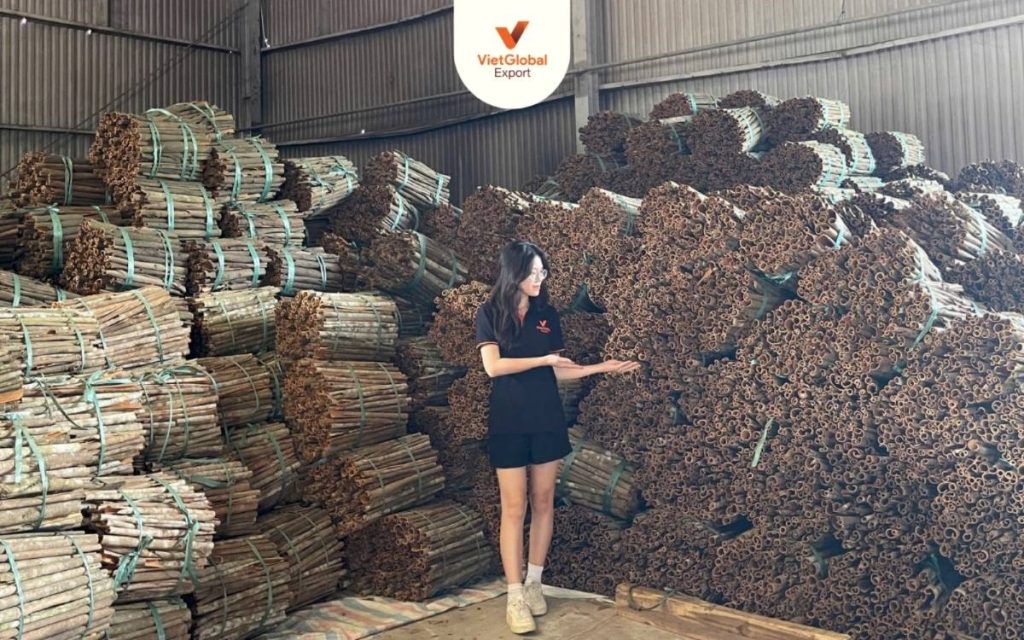
Cassia cinnamon: off-season supply is tightening
Vietnamese cassia cinnamon is normally harvested during two main periods. The spring peeling season generally runs from March to May, while the autumn crop begins from around late August or September and may continue into the final months of the year.
By July, the first major harvest has ended across most growing areas in Yen Bai and Lao Cai.
Fresh bark is no longer entering the market in the same volume as during peak season. Processing facilities are relying more heavily on raw material and semi-finished stocks collected during the previous months.
This does not mean cassia is unavailable. However, buyers may notice that:
- Raw bark is less abundant.
- Available materials may be less uniform.
- Attractive whole-stick grades become more difficult to select.
- Raw material costs may increase as inventory declines.
- Production lead times can become longer for specific grades.
Products requiring good appearance, thickness and rolling percentage – such as cigarette cassia, tube cassia and long cassia sticks – may be more affected than broken cassia or materials intended for grinding.
Rainy-season risks for cassia
July is also part of the rainy season in northern Vietnam.
Heavy rain, high humidity, thunderstorms and tropical weather systems can interrupt peeling, sun-drying, sorting and packing. Even when factories have sufficient raw material, unstable weather may slow production.
Moisture control therefore becomes especially important.
Cassia that is insufficiently dried or exposed to moisture during storage can face a higher risk of:
- Mould development
- Darkening or uneven colour
- Musty odour
- Reduced shelf life
- Quality deterioration during sea transport
Buyers should not evaluate cassia only by photos or external appearance. Moisture should be checked before packing, and finished cartons should be stored away from wet floors, walls and open production areas.
Buyer recommendation for cassia
Importers planning Q3 production should discuss volume and specifications early rather than assuming that lower-priced raw material will remain available until the next crop.
The autumn harvest may begin from late August to September, depending on the growing region, rainfall and bark condition. However, fresh harvest does not become export-ready immediately. The bark still needs to be dried, processed, classified and packed.
Early planning can help buyers protect their production schedules and avoid rushing quality approval.
Star anise: moving toward the autumn harvest
Vietnam has two principal star anise crops.
The smaller spring crop is normally collected during the early months of the year. The larger autumn crop begins later, with early harvesting appearing in some areas from July or August and broader volumes commonly reaching the market between August and October.
This makes July a transition period.
Spring-crop stocks may still be available, while farmers and processors begin monitoring the maturity of the approaching autumn crop. Harvest timing can differ between districts because of altitude, weather and fruit development.
For buyers, an early crop does not automatically mean better quality.
Star anise picked before reaching suitable maturity may have:
- Smaller flowers
- Weaker aroma
- Lower essential oil performance
- Less developed seeds
- Higher breakage during drying
Buyers looking for premium whole autumn star anise should therefore evaluate actual samples rather than confirming an order only because it is labelled “new crop.”
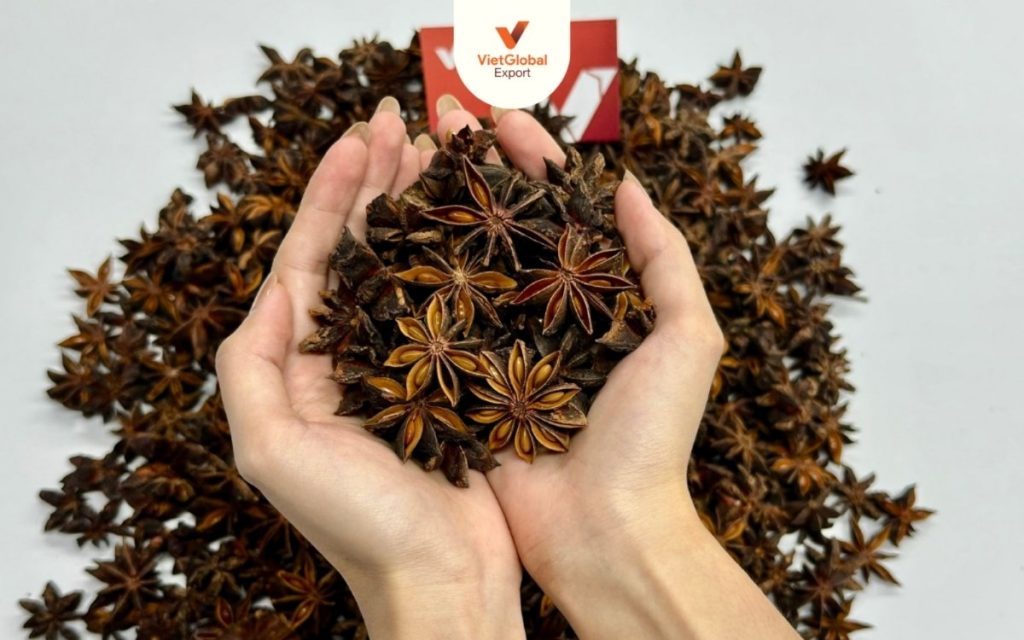
Packing matters as much as flower size
Many buyers focus mainly on flower size, colour and broken percentage. These are important, but they do not tell the complete story.
A good star anise shipment should also be assessed for:
- Aroma strength
- Essential oil content, when required
- Moisture
- Cleanliness
- Stem and foreign-matter content
- Mould or insect condition
- Packing quality
Star anise is highly aromatic, but it can lose commercial value when it absorbs moisture during storage or transportation.
Dry cartons, suitable inner protection and careful container loading are particularly important for long-distance shipments or humid destinations. Cartons should not be loaded while wet, and the container should be inspected for leakage, odour and excessive condensation risk.
Buyer recommendation for star anise
Buyers planning autumn-crop purchases should begin discussing specifications before the crop reaches full volume.
This allows time to compare early samples, clarify acceptable colour and broken rate, and decide whether the application requires premium whole flowers, standard whole star anise or broken material for grinding and extraction.
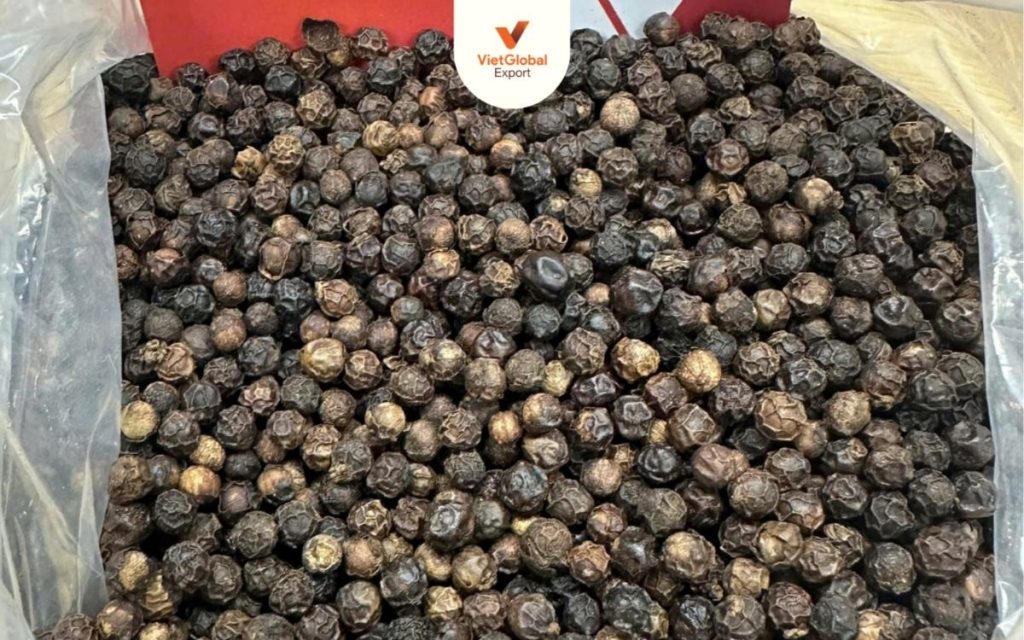
Black pepper: an inventory-driven and volatile market
Vietnam’s main black pepper harvest generally runs from February through April, although exact timing varies between growing regions.
By July, significant new-crop material is no longer entering the market. Most pepper is traded from stocks held by: farmers, local collectors, traders, processing factories, exporters
This makes the market inventory-driven. However, inventory-driven does not mean inactive or predictable.
During the first half of July 2026, Vietnam’s domestic pepper market experienced noticeable short-term movement. Domestic prices rose during the week ending July 12, while export quotations moved in a different direction.
This divergence shows why buyers should not rely on one general market-price headline.
Why actual pepper availability matters
A supplier may have pepper available but not necessarily in the exact grade required by the buyer. Farmers with stronger financial positions may also release stocks gradually rather than selling immediately. At the same time, processors need to balance incoming orders, export commitments and the amount of suitable raw material available for cleaning.
As a result, a stable price on one particular day does not necessarily indicate abundant supply.
Buyer recommendation for black pepper
Buyers should confirm actual factory stock and processing capacity for the required specification.
A serious availability check should include:
- Required density
- Moisture
- Admixture
- Cleaning level
- Microbiological standard
- Steam-sterilisation requirement
- Pesticide-residue limits
- Packing
- Production and loading schedule
For buyers serving the EU or other regulated markets, residue compliance should be discussed before confirming the raw material – not after production has already started.
Black cardamom: the product to watch from late July
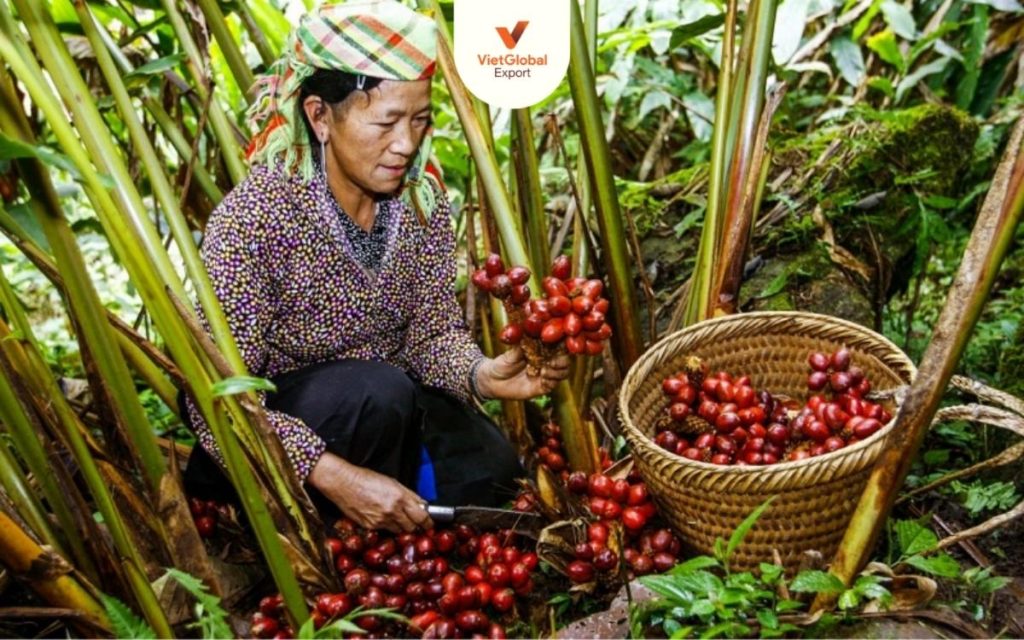
Vietnamese black cardamom grows mainly in cool, high-altitude areas of northern Vietnam. It performs best under forest canopies and in humid mountain environments.
Unlike pepper or cassia, black cardamom is produced in relatively limited areas. Its supply chain is smaller, more fragmented and strongly influenced by local weather.
Harvesting may begin from late July in some areas and continue through August, September or October, depending on altitude and pod maturity.
July should therefore be described as the beginning of the sourcing window rather than the full peak season.
Why pod maturity matters
When demand is strong, farmers or collectors may be tempted to harvest early. However, immature pods may not provide the aroma, seed development or drying performance expected by experienced buyers.
A black cardamom inspection should cover:
- Pod maturity
- Pod size and shape
- External colour
- Seed development inside the pod
- Smoky aroma
- Moisture
- Broken or empty pods
- Admixture
- Mould or musty odour
- Drying consistency
External colour alone is not a reliable quality indicator. Black cardamom is traditionally dried with heat and smoke, gradually changing from its fresh reddish-purple colour to a brown or brown-black commercial appearance. Poorly controlled drying can result in burnt odour, excessive blackening, uneven moisture or mould inside the pod.
The most important test is often to open several pods and examine the seeds.
Buyer recommendation for black cardamom
Buyers should begin discussions during the early crop but avoid approving large orders before checking representative samples.
Because supply is limited, better-quality lots can be selected quickly. Early engagement gives buyers more time to compare pod size, aroma, inner seed condition and drying quality.
Prices should also be compared on a like-for-like basis. A large, well-filled and carefully dried pod cannot be evaluated against a smaller or partially empty grade based only on price per tonne.
July sourcing priorities for importers
For cassia cinnamon, plan purchases early and pay close attention to moisture management during the rainy season.
For star anise, follow the approaching autumn crop, but evaluate maturity, aroma and packing – not only flower size.
For black pepper, monitor actual stock by grade because the post-harvest market can remain volatile even when daily prices appear stable.
For black cardamom, watch the early harvest closely and inspect the inside of the pods before approving quality.
Frequently asked questions
Is July a good time to buy Vietnamese cassia?
Cassia remains available in July, but it is an off-season period between the main crops. Buyers may face tighter raw-material supply, firmer prices and longer production times for attractive whole grades.
When does Vietnam’s autumn star anise crop begin?
Early harvesting may start in certain areas from July or August, while larger volumes are generally available between August and October. Timing varies by district and weather.
Is Vietnam black pepper still in the harvest season in July?
No. The main harvest normally ends around April. July supply comes largely from stocks held by farmers, collectors and processors.
When is Vietnamese black cardamom harvested?
Harvesting can begin from late July and continue until October, depending on altitude, location, weather and pod maturity.
Your local sourcing partner in Vietnam
When buyers are thousands of kilometres away, market availability can look simpler than it really is.
A product may be available – but not in the right grade. A new crop may have started – but not yet reached suitable maturity. A quotation may appear competitive – but the material may require additional drying, cleaning or selection.
This is where local sourcing support matters.
At VietGlobal Export, we work directly with growers, collectors and processors to help international buyers understand what is happening at origin.
From crop monitoring and sample checking to quality inspection, packing and logistics, we act as your eyes, ears and hands on the ground.
We do not just export spices – we represent you in Vietnam.
Contact our team with your required product, specifications, destination port and planned quantity for the latest availability and sourcing advice.
